The number line is often the first visual model students encounter when learning to add and subtract integers. Yet in practice, the concept tends to flatten into routine: draw arrows, count spaces, move left or right. Many students go through the motions without understanding what those motions represent.
To make this process more concrete, our team developed the Interactive Number Line Simulation—a browser-based tool that lets students see how numbers combine and move in real time. The simulation works in two modes: a Sandbox Mode for open exploration and a Quiz Mode for self-testing and practice.
In Sandbox Mode, learners enter any starting value and the number to add or subtract. The simulation then displays the full equation, a step-by-step explanation, and a dynamic number line showing direction, distance, and the final result. Instead of static arrows on paper, the motion itself becomes the teaching moment: adding a positive number moves right, adding a negative number moves left. This immediate visualization helps students internalize integer directionality and magnitude relationships—ideas that are foundational but often misunderstood.
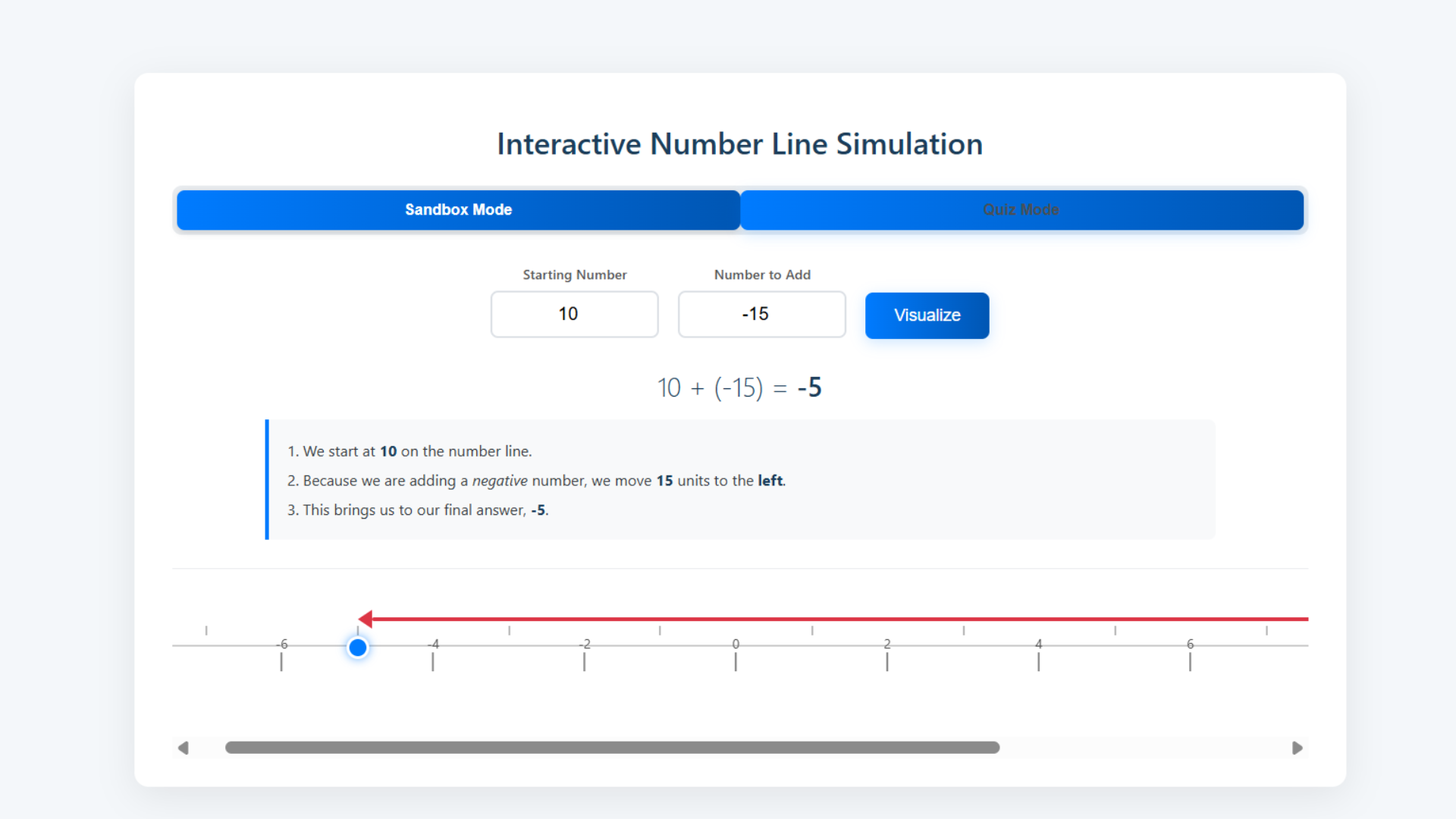
In Quiz Mode, the same logic becomes interactive practice. The simulation generates random problems, provides instant feedback, and reveals the reasoning visually. Students can retry until they get it right, observing each correct path as it unfolds on the number line. The feedback loop is quick, clear, and self-paced—ideal for tutoring centers or supplemental math labs where independent practice is essential.
For tutors and instructors, the simulation serves as a flexible demonstration tool. It can support guided explanation during one-on-one sessions, help visualize student errors, or introduce digital exploration into lessons without complex setup. Because it runs entirely in a web browser, it can be shared easily across classrooms, labs, and online tutoring environments.
For students, the value lies in the clarity of movement. Integer operations stop being abstract symbols and start behaving like physical actions. For educational programs, the tool models an accessible, low-cost way to blend interactivity and pedagogy—a small but significant step toward technology-enhanced math learning.
The Interactive Number Line Simulation reinforces a simple idea: when students can see how numbers move, they can start to reason about why.