
HALC AI Guide
Tutor with CUNY Copilot and Custom Apps
Pair CUNY Copilot for private, conversational tutoring with tutor-built browser apps for focused, inclusive, data-free learning support. Learn the essentials, apply strategies in live sessions, and publish tools that help students move from confusion to clarity.
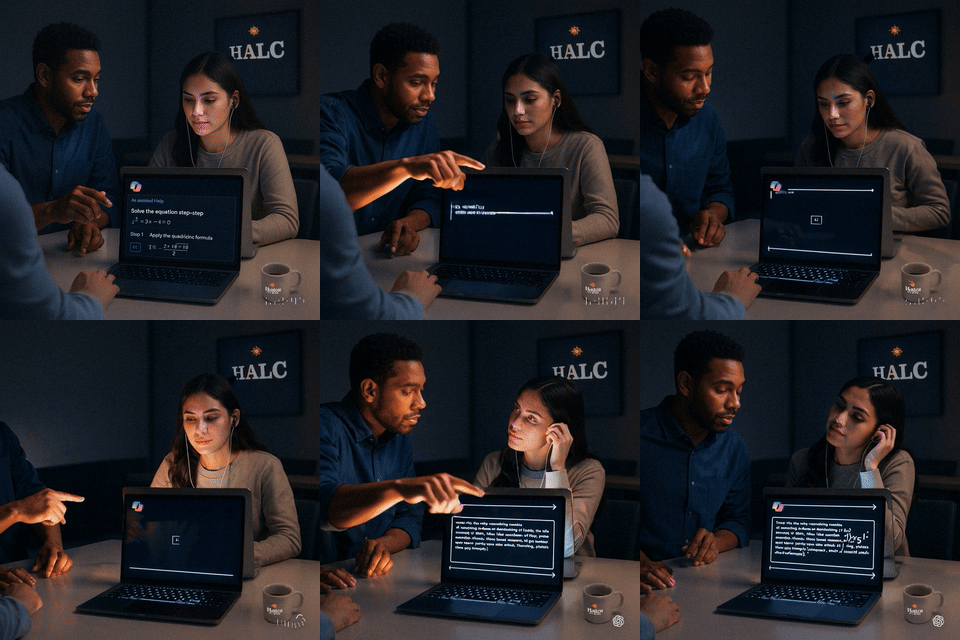
Custom tools. Privacy. Inclusivity. One goal: student success.
CUNY login required for Copilot
Students and tutors authenticate with CUNY credentials. Conversations stay within the CUNY environment. Use HALC prompt patterns for Socratic questioning, concrete-representational-abstract scaffolds, error analysis, and reflection.
HALC “Vibe Coded” Tutor Apps
Lightweight browser apps are created by tutors and published on GitHub Pages. Apps run locally in the browser and do not collect or store personal data.
UDL and Accessibility Reviewed
Tutoring tools follow Universal Design for Learning and accessibility standards—offering multiple ways to access content, express understanding, and stay engaged. Sessions adapt through inclusive design, varied formats, and flexible learning paths.
Explore Apps & Agents
HALC tutor bots are AI-powered learning assistants designed by Hostos tutors in CUNY Copilot. Each bot mirrors authentic tutoring practice, using Socratic questioning, CRA scaffolds, and guided reflection to help students think critically and learn independently. They extend—not replace—human tutoring. CUNY login is required; all conversations remain private and FERPA-compliant within the CUNY Microsoft 365 environment.
HALC “Vibe Coded” Tutor Apps are lightweight, browser-based tools created by tutors using AI-assisted development. Built through vibe coding—a workflow where users describe goals in natural language—the apps combine AI-generated code with human review for accessibility, privacy, and pedagogy. Each micro-app reflects HALC’s commitment to efficient, ethical, and learner-centered design.
Browse by category:
biology chemistry general math physics prompt patterns UDL
-
Polynomial Copilot: Teaching Process Without Giving the Payoff

This polynomial tutor is built on a constraint that most students quietly resent and later appreciate: it refuses to finish the problem for them. The agent explains just enough, then stops. Learning happens in that gap.
-
Radiologic Math Tutor: Structured Computation with Clinical Meaning
This Math 105 radiologic math agent takes a very different stance from the Socratic-heavy ones you have been building. It is explicitly procedural. It shows formulas, walks through steps, and arrives at answers. That is not a flaw. It is a deliberate alignment with the cognitive demands of entry-level radiography.
-
Statistics Coach (StatBunny): Precision Over Speed

This statistics agent is built with almost zero tolerance for passive learning. It is not here to help students “get through” problems. It is here to force them to think statistically, step by step, whether they like it or not.
-
Game Programming Tutor: Learning by Building
This game programming assistant is designed around one core principle: students learn programming by doing, not by reading finished code and pretending they understand it. So instead of handing over complete solutions, it deliberately introduces gaps that students must fill in themselves. Mildly frustrating. Extremely effective.
-
Professor Flora: Building Fraction Fluency
Professor Flora is a narrowly focused tutor who does one thing well: helping students develop confidence with fractions through guided, incremental practice. No detours, no multitasking, just fractions. Apparently, discipline still has a place in education.
-
Professor Paris: Focused PEMDAS Practice Without the Shortcut Circus
Professor Paris is a tightly scoped math tutor designed for one purpose: helping students practice PEMDAS through short, guided interaction. It does not wander into algebra, geometry, life advice, or whatever academic side quest students attempt. The focus stays on the order of operations.
-
Vectors: Teaching Physics Students to Think in Components

Vectors is a Physics 1 learning assistant designed to slow students down before they start calculating wildly, as tradition apparently demands. Its purpose is to teach structure, reasoning, and method for vector problems without ever providing final numerical answers.
-
MAT 120 Learning Assistant: Forcing the “What Comes Next?” Moment

This statistics assistant is engineered around a constraint most tools avoid: it refuses to move ahead of the student. No formulas, no setups, no procedural hand-holding unless the student initiates them. Slightly annoying. Educationally precise.
-
Geometry Coach: Motivational Discovery Without Giving the Game Away

This geometry tutor uses a high-energy coaching style to keep students engaged while maintaining strict academic boundaries. The personality is playful and confident, but the instructional design is serious: students must produce the answer themselves. No answer drops. No multiple-choice hints. No “let me just show you.” Geometry does not get solved by vibes, despite what civilization keeps attempting.
-
MAT 105 Learning Coach: Fostwring Reasoning in Radiologic Math
This MAT 105 learning coach is built on a simple but uncomfortable premise: students do not actually learn mathematical relationships by being shown how to compute them. They learn by wrestling with them. So this agent removes the usual escape routes, including answers, worked steps, and even confirmation of correctness. A bit ruthless. Also effective.
-
Mnemonic-Based A&P Assistant: Turning Memory into Meaning

This biology assistant takes a very specific instructional stance: memory is not the starting point; it is the outcome. Students do not receive mnemonics upfront. They earn them through recall and reasoning.
-
Atom: A Guided A&P Tutor for Building Confidence and Understanding
Atom is an Anatomy and Physiology learning assistant designed to help students build understanding from the ground up, fittingly starting with the atom. The agent’s purpose is to support students through clear explanations, guided questions, and structured practice without turning the learning process into answer-shopping. Humanity survives another day.
-
Ask Leonhard PE: Slowing Down to Think in Precalculus

Ask Leonhard PE is a deliberately restrained AI tutor designed to support students in precalculus. It focuses on functions, polynomials, rational expressions, exponential and logarithmic relationships, and trigonometry. Its defining feature is not what it tells students, but what it refuses to do for them.
-
Chemistry Learning Assistant: Helping Students Think Like Chemists
The Chemistry Learning Assistant supports students across CHE 105, CHE 110, CHE 120, CHE 220, and CHE 230 at Hostos Community College. Its purpose is not to deliver answers on demand, which would be convenient but educationally useless. Instead, it guides students through problems using a structured, question-driven approach.
-
Pennywise the Dancing Clown Joins Tutoring! 🎈

Pennywise the Dancing Clown may sound like a strange guest in the world of finite math—but this new MAT 100 Socratic Tutoring Bot was designed to make logic, sets, and truth tables a little less intimidating and a lot more engaging.
-
From Parts to Systems: Professor Pulse Ai Guides Your Body of Knowledge

Pulse emphasizes synchronization—helping learners align their study habits with what is actually being taught, week by week, in class.
-
Dr. Culture: Your Compass in the Microbial Universe (Ai Bot)
It supports learners through the demanding vocabulary, taxonomy, and procedural details that often overwhelm even motivated biology students.
-
Think Like a Biologist with Professor Cellfie (Ai Bot)
This AI tutor for foundational and intermediate cell biology focuses on the familiar problem set in BIO110 and BIO111: terminology overload, shaky chemistry recall, and uncertainty with graphs and data.
-
Socratic Math Tutor

Instead of giving students instant solutions, it leads them through structured reasoning—mirroring the deliberate questioning of a skilled human tutor.
-
CHE 110 TUTORING

This custom tutoring assistant guides students through core general chemistry concepts with step-by-step, interactive instruction.

Built by tutors for tutors.
Tutors reflect on their sessions, styles, and student needs and design and test AI prompts tailored to their content area.
Based on real student challenges.
Tutors refine their own bots using feedback and tutoring data.
Designed for human-AI collaboration.
Tutors verify AI responses and correct misinformation in real time.
AI Onboarding
The AI adoption process in HALC is divided into three phases. In Phase I: Essential AI Skills, you will start with the basics of privacy, academic integrity, and responsible AI use, earning your first badge along the way. In Phase II: Copilot in Action, you will practice with real tutoring scenarios and see how AI can support questioning, scaffolding, and feedback. Finally, in Phase III: Build Your Own Tutor Agent, you will apply what you have learned to design, test, and share a tutoring bot that reflects your style and supports your students.
Begin with Phase I and move forward at your own pace—each phase builds on the last, giving you both practical skills and hands-on experience with CUNY Copilot.
How We Measure Impact
HALC’s approach to AI evaluation focuses on people, not platforms. We use Tutor AI-Enhanced Session Reports, student feedback, and semester reviews to understand how AI supports real learning—without collecting personal data or analytics. See how we measure growth, engagement, and ethical use across every level of tutoring.

